Showing posts with label end mill. Show all posts

Tuesday, September 4, 2012

Our Philosophy on End Mills: Coatings


We've spent a great deal of time insuring that our coatings work in conjunction with all the other aspects of our end mills.  We have three primary coatings for our tools. Here's some details on what they are and where to apply them for your cutting material applications.

Black Stealth
Black Stealth Coating MoS2

Molybdenum Disulfide (MoS2). The easiest way to understand our Stealth coating is to think of the coating as being ‘clear’ and not ‘black.’ As soon as the tool enters the cut many people comment that the “color has worn off.”  We can assure you that this is not the case. There’s several physical and chemical changes that cause this visual change and space does not permit here to explain the science. That’s part of the reason we call it “stealth” because you can’t see it any more!  What’s important is the this coating has a lower co-efficient of friction than just about everything else on the market. Our geometry works ideally with this coating. Used for our Viper and DiamondBack series tools which are for all Non Ferrous Alloy milling (N)

AlTiN 
AlTiN Coating

Aluminium Titanium Nitride  This PVD coating has a gradually increasing percentage of aluminum added as it goes through the coating process. It gradually increases in the amount of Aluminum from the substrate interface until it reaches the outer surface of the coating, where there is a higher percentage (up to 65%) of aluminum in the film. As the tool heats up, the aluminum converts to aluminum oxide, staying in the film. This coating provides exceptional oxidation resistance and extreme hardness. AlTiN retains its hardness when the temperature is 800° to 930° C (1,470° to 1,700° F) This coating is ideal for dry machining environments. Used exclusively on our Raptor products for all P - Steels (blue), M - Stainless Steel (yellow), K - Cast Iron (red), and S - Hi-Temp Alloys Special Alloys & Titanium - (brown) materials. 

Please keep in mind that this coating CANNOT be used in Aluminum (N) machining because the Aluminum in it would have an affinity to itself and cause workpiece adhesion to the cutting tool.

X-Treme 
TiAlN Xtreme Coating

Titanium Aluminium Nitride (TiAlN) This monolayer PVD coating has high hardness and excellent thermal stability that protects against premature tool wear. It also has excellent oxidation resistance allows high speed and semi dry or dry machining operations. Used for our Cobra and Python series tools which are for all P - Steels (blue), M - Stainless Steel (yellow), K - Cast Iron (red), and S - Hi-Temp Alloys Special Alloys & Titanium - (brown) materials


Saturday, September 1, 2012

Our Philosophy on End Mills: Tolerance


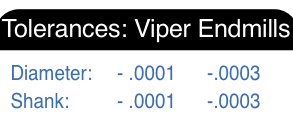
When we talk about tolerance we are actually referring to two components of our end mills.  Our shank diameters are held tighter than standard h6 industry specifications of -0.0001” / -0.0003”.  Our Viper and DiamondBack End Mills are held to -0.0001" / 0.0003" on diameter and shank. However, that is just part of the story...

We’ve really concentrated a lot of time on the grinding tolerance as well. When you look at our competitors under a microscope many times you will see that the primary and secondary grind finish looks like a washboard texture because of the wheel that was used to finish grind it with.  

End Mill performance in high speed machining is dependent upon the surface roughness (topography) of the rake face and and relief face of the end mill.  Better, smoother ground surfaces reduce the co-efficient of friction and permit the tool to perform better “in the cut”.  As we talked about in our previous posting with regard to geometry, we make every attempt to reduce the co-efficient of friction that a chip encounters as it is being formed into 6's & 9's in our end mills.  We take special care to insure that our wheels are re-dressed quite often to maintain consistent surface finish. And that has an impact on coating adhesion as well. We'll be discussing that in our next posting.

Friday, August 24, 2012

Our Philosophy on End Mills: Carbide Substrate

The most commonly used term for carbide is “Micro-Grain” but it does NOT really describe the differences that have evolved since the first development of “Micro-Grain” in the past 40-50 years. Fine, Ultra-Fine and Sub Micron grains are some of the current terminology that is used.

Two other commonly used terms are “toughness” and “wear resistance.” We’ve found that neither term can be used as a proper gage. Here’s why:
  • Toughness - Fracture toughness is not only a characteristic of the material but also a function of the loading conditions. Carbide rod is measured for "toughness” before geometry has been ground into the tool and a finished, ground tool can vary as much as 300% in “fracture toughness” based upon geometry alone.
  • Wear Resistance - Cutting tool wear is a result of complicated physical, chemical, and thermo-mechanical actions. Tool wear is caused by such mechanisms as adhesion, abrasion, diffusion & oxidation that all act together with predominant influence of one or more of them in different situations within the CNC machine, which is quite different from lab testing.

Cemented Carbide is similar to cement in more than name only. Cobalt is the “lime” that holds the Carbide “gravel” together. If a large chunk of carbide is exposed at the cutting edge it will fracture off just like a piece of gravel on a cement walkway edge. 
Destiny Tool Substrates compared to our competitors

Bottom Line: At Destiny Tool, through over a decade of testing, we have selected substrates that work together with our tools for optimal tool life and performance in specific materials. Our substrates range from a transverse rupture strength of 580,000 - 630,000 psi and vary in cobalt content from 10 -12% based upon the specific application that the tool was designed. You can trust that we’ve selected the correct substrate for your application material.

Tuesday, August 21, 2012

Our Philosophy on End Mills: Introduction


At Destiny Tool we believe that and end mill is only as good as the engineering that is behind it.  We’ve cut our teeth in non-ferrous and hi-temp alloys for many years and we believe that our performance end mills are the very best available int the global market for those specific material groups.  In our view, there are four major components that make up a performance end mill:
  • Substrate
  • Geometry
  • Tolerance
  • Coating
In the next few weeks we'll be detailing out each of these to help you better understand how to apply our end mills in your CNC milling machines. Stay Tuned for more information!